

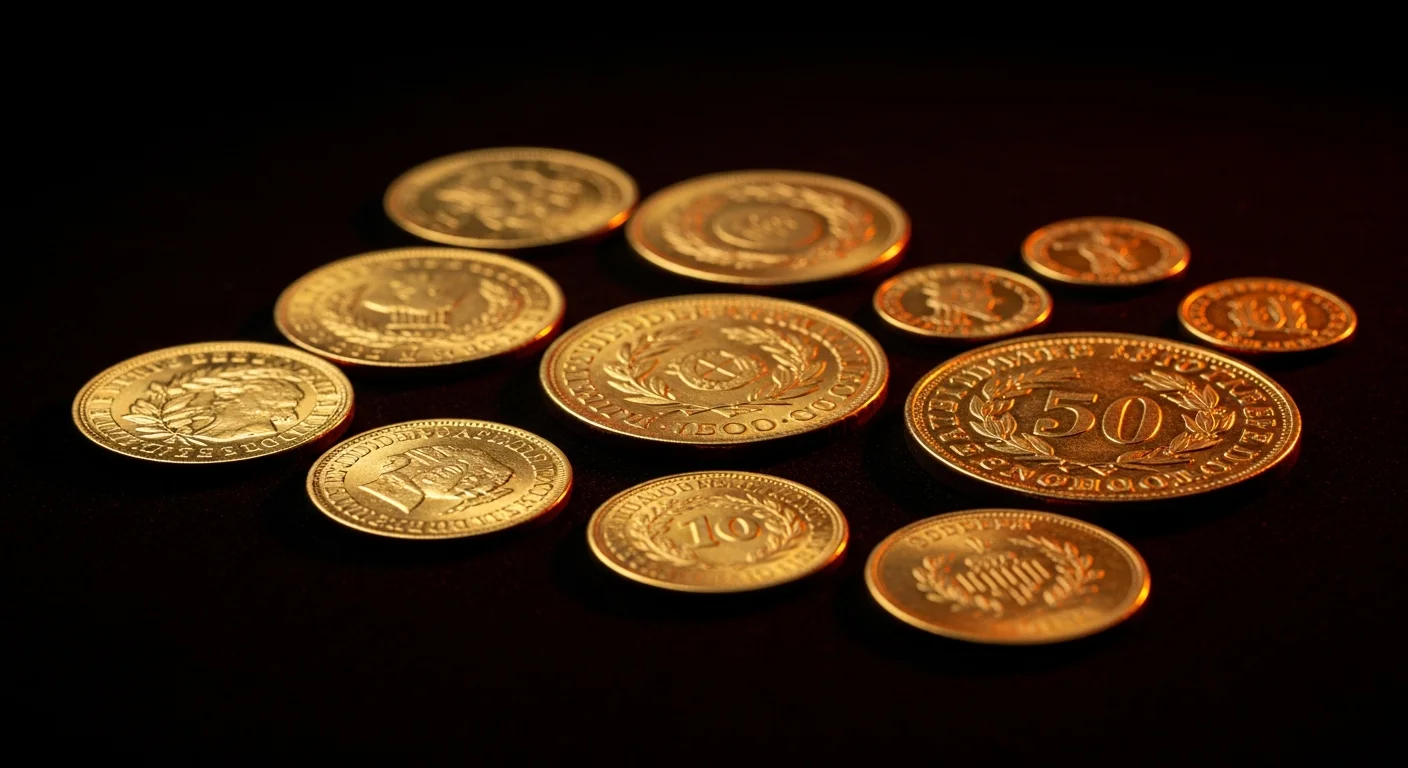
How Storage Affects Value
A coin's value is largely determined by its grade. An MS-65 purchased today can drop to MS-63 or MS-62 upon resubmission if improper storage causes surface toning or hairlines. Even a two-grade slip can cut market value by a substantial fraction — or by multiples — for rare specimens.
Conversely, consistent correct storage preserves the coin exactly as purchased, maximising its value when you decide to sell. Storage is one of the best investments a collector can make.
- Ideal temperature
- 15–20 °C
- Ideal humidity
- 40–50 %RH
- UV exposure
- Block entirely
A coin's greatest enemies are moisture, UV light,
and well-intentioned cleaning.
Correct Handling — The Basics
Always wear clean cotton or nitrile gloves when handling coins. Bare-hand contact deposits skin oils onto the surface, which cause uneven toning and corrosion over time. High-grade coins with residual mint luster — and especially Proof coins with mirror-like fields — are extremely sensitive to skin contact.
- • Hold by the edge
- • Wear cotton or nitrile gloves
- • Work over a thick cloth or towel
- • Avoid breathing directly over the surface
- • Touch the obverse or reverse with bare fingers
- • Grip the fields (flat surfaces) directly
- • Handle over a hard bare surface
- • Rub slabs against each other
Always hold coins by the edge. Avoid touching the field (flat surface) or devices (design elements) directly. Work over a thick cloth or towel to cushion any accidental drops — edge contact with a hard floor is one of the most common causes of grade-reducing marks.
The Dangers of Cleaning
Natural toning — the organic colour change that develops over decades — is a hallmark of a coin's history and is often actively sought by collectors. Rainbow toning and caramel toning can carry significant market premiums. A coin that looks "dirty" may in fact be desirable exactly as it is.
If a coin's surface concerns you, consult a professional first — our staff or a grading service specialist. Any intervention should only be carried out by an expert familiar with numismatic conservation.
Choosing the Right Container
The two governing principles for container selection are: minimise contact between coin and air, and choose chemically inert materials. Here are the most common options, rated.
- BEST
Certified Slabs (PCGS / NGC)
Acrylic encapsulation holders. Both sides visible without direct contact; reasonably stable under temperature and humidity fluctuations. The optimal choice for high-grade coins.
- GOOD
Air-Tite Capsules
Polycarbonate sealed capsules with an O-ring to minimise air exchange. Suitable for temporary storage of ungraded coins awaiting submission. Choose the correct size.
- OK
Mylar Flips
PVC-free transparent film folding holders. Always confirm the material is Mylar (polyester), not PVC. Suitable for short to medium-term storage.
- AVOID
PVC Albums & Flips
Soft clear plastic. Over time, PVC off-gasses chlorine compounds that corrode coin surfaces. Avoid entirely.
- AVOID
Rubber Bands, Paper Bags, Plastic Bags
Sulphur compounds and skin oils migrate to the coin surface, causing toning and corrosion. Newspaper and tissue paper are also problematic.
Temperature, Humidity & Light
Moisture and sudden temperature swings are a coin's worst environmental enemies. The ideal storage environment is stable at 15–20 °C and 40–50 % relative humidity. Avoid bathrooms, kitchens, direct sunlight, window sills, and proximity to heating appliances.
UV light also accelerates toning and discolouration. If displaying coins, use UV-blocking glass frames and avoid direct sunlight. For long-term storage, a dark location is optimal.
Storing Certified Slabs
PCGS and NGC slabs are designed to protect their contents, but additional care extends their life considerably. Store multiple slabs in dedicated slab boxes or briefcase-style collection cases to prevent friction scratches and maintain organisation.
Protect slabs from drops and impacts by wrapping individually in bubble wrap or padding inside a cardboard box. Slab acrylic scratches easily — avoid wiping with towels or rough materials; if needed, blot gently with a dry cotton cloth.